

Reduce Energy Costs: How Airius Fans Cut Bills by 30%
For more than 3,000 years, people have used air movement to feel cooler and more comfortable in warm climates — whether the airflow comes from natural ventilation or fans. In modern buildings, the same principle applies: increased air speed can significantly improve thermal comfort in both hot and humid and hot and arid environments.
For example, research by Zhang et al. (2007) shows that overheated people actively seek more air movement in hot and humid tropical environments.
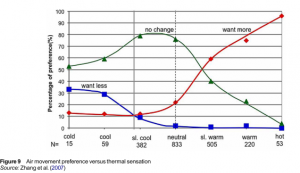
In further research, Professor Richard Aynsley, formerly Professor of Tropical Architecture at James Cook University in Queensland, details how air movement of 3 m/s can deliver around 7°C of SET (Standard Effective Temperature) cooling on a 36 °C, 70% humidity day.
In practical terms, that means a person on a 36 °C humid day can feel as if it is around 28 °C — purely from increased air movement. If you use efficient fans to create that air movement, the cooling effect can be achieved for very low energy input.
Generally, this level of air movement can be achieved using large-bladed HVLS fans or very low energy Airius® Air Pears.
Air conditioning systems are not designed to provide this kind of controllable, directional, relatively high-speed air movement throughout a space, especially at or near floor level where occupants need it most.
Typical air conditioning registers discharge at around 0.2–0.5 m/s at ceiling level. Airflow velocity therefore becomes very limited at ground level, and a lot of energy is wasted trying to push cold or warm air down to the floor.
By contrast, fan‑based air movement within the room itself can offer significant energy savings in summer in air‑conditioned spaces by substituting air‑conditioning supplied cold air with cooling air movement up to a certain temperature.
In many commercial buildings, air conditioning can consume 30–60% of total building energy.
If we follow the research noted above (and further research detailed in our Airius blog “Air Movement for Cooling in Hot and Humid and Hot and Arid Environments”), we know that air movement can provide notable comfort improvements in warmer and hot climates.
It is not perfect, but it is a strong alternative if you want to maintain comfort and reduce air‑conditioning energy use.
In facilities such as offices or supermarkets, 3 m/s air speed is often too high. In those spaces, 1–1.5 m/s can provide a perceived 3–4°C reduction in temperature. In other facilities such as sports halls or warehouses, 2–3 m/s can be acceptable.
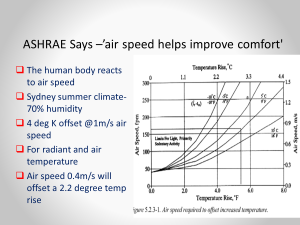
In the chart below, ASHRAE indicates that in a Sydney summer climate, only 1 m/s air speed can offer around a 4 °C temperature offset.
If you or your client are interested in saving air‑conditioning cooling energy without major changes to the system or facility, fan‑driven air movement deserves careful consideration.
Dr Vahid Vakiloroaya from the University of Western Sydney — winner of the 2016 Innovative Engineering Award from Engineers Australia and designer of the IP Hybrid Air Conditioning system — has conducted research into energy savings achieved simply by changing thermostat settings in the Sydney summer climate. His work indicates significant energy savings through set‑point adjustments alone.
This concept is not new. There is extensive research on the amount of energy savings achievable per degree Celsius of thermostat change. While the precise figures vary with conditions, 8–10% energy saving per °C is often quoted as a typical range.
If you accept that air movement can substitute for cooling across a range of climatic conditions and comfort expectations, then combining air circulation with air conditioning in summer can deliver energy savings of up to (or more than) 30%, while still maintaining a high level of thermal comfort — simply by installing fans and changing the A/C thermostat in the space.
Have a look at this graph from Dr Vahid’s research:
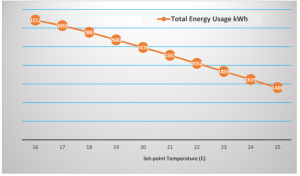
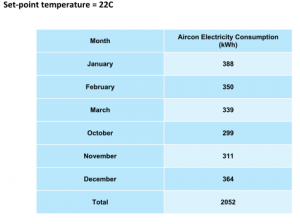
Dr Vahid undertook simulations in Sydney’s cooling seasons (January, February, March, October, November and December) using a 5 kW wall‑mounted split air‑conditioning unit in an office building.
If we consider a typical building with a set point of around 22°C, and we know that 3 m/s air movement can offer a 7 °C cooling effect on a hot and humid day, then the impact of air movement in a drier, conditioned environment, where humidity is lower, may be even greater.
It would be possible to increase the thermostat from 22 °C to 26–27 °C on a hot day while using 1–1.5 m/s air speed as an energy‑efficient cooling substitute. Occupants would feel like the temperature is around 22–23 °C. That is what recent thermal comfort research indicates.
Based on Dr Vahid’s results, increasing the thermostat from 22 °C to 25 °C can save around 30% of cooling energy — achievable with only 0.8–1 m/s air speed.
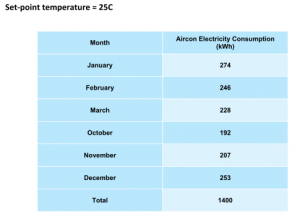
Dr Vahid indicates that each degree increase in thermostat set point in summer can save around 8–9% of the air‑conditioning system’s cooling energy use.
Over 3 °C, that can be a 25–27% saving.
Over 5 °C, that can be around a 40% saving.
At an internal set point of, say, 27 °C, air movement as a substitute for some air conditioning can offer the same perceived level of thermal comfort as a 22 °C space — while saving up to 40% of cooling energy.
This becomes particularly significant when implemented into larger A/C systems.
If you are spending, for example, $100,000 per annum on cooling in a large facility, that equates to a $25,000–$40,000 energy saving per year from this approach alone.
Returns on investment can be very short, as fans themselves are relatively inexpensive. If you aim for a 2‑year ROI, with those savings you could theoretically invest up to $80,000 in fans, recover that in 2 years, and then save around $40,000 per year thereafter.
What About Heating?
If your building also has significant heating requirements, high‑quality air circulation — and particularly destratification fans that both circulate air in summer and destratify in winter — can also save large amounts of heating energy.
When you heat a building, warm air naturally rises to the roof or ceiling. Regardless of A/C register design or the type of heating (radiant, in‑floor, etc.), most of the warm air makes its way up to the top of the space.
That is not where you need it.
What you really want is to push that warm air down to floor level so occupants feel the heat, and to stop over‑delivering warm air that simply makes the ceiling warmer rather than people. This over‑delivery (waste) of heat significantly increases your heating bill for no benefit — it is wasted heat and wasted energy.
Standard air delivery systems struggle to push warm air down to the floor because it is lighter than cold air and continually wants to rise. This is especially difficult in very cold facilities where dense cold air sits in thick layers at floor level.
This is where an air turbine design is valuable. Located near the roof, its patented and unique design can push lighter warm air down and through dense cold layers, destratifying the space and optimising heating effectiveness.
Once explained, it makes intuitive sense — no smoke and mirrors.
In the UK, detailed research was undertaken on the effectiveness of air turbines in destratifying heated spaces. The outcomes have since been replicated worldwide in real‑world installations.
The chart below highlights heating energy savings achieved by using air turbine destratification fans. This research was carried out by BSRIA (similar to the UK’s CSIRO).
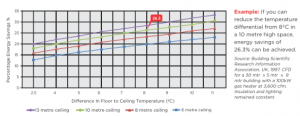
The research indicates that, for example, in a 6‑metre‑high space with a 6 °C difference between floor and ceiling temperatures (stratification), a heating energy saving of around 18% is achievable — even before any thermostat adjustments in the room.
Usually, 0.75–1 °C temperature increase per metre of height is typical of stratification levels in a building.
In winter, if you decrease the thermostat from, say, 22 °C to 20 °C (as often happens when destratification is implemented and comfort improves), even greater energy savings can be achieved.
By using air circulation in summer alongside thermostat adjustments, and effective destratification in winter, significant air‑conditioning energy savings are possible.
Of course, implementation costs and practicalities must be considered. Large‑bladed fans can introduce installation challenges and costs in many building types, such as offices or supermarkets, where HVLS fans, roof structure modifications, three‑phase power requirements and ongoing maintenance can make them impractical or too expensive.
To create the best value, small but powerful air turbines manufactured by Airius® are often the easiest and most cost‑effective solution.
This smart product selection leads to even shorter paybacks. Their proven effectiveness in providing strong air movement for summer cooling and effective destratification for winter heating — combined with very low power use and ease of installation — makes them a simple energy‑saving solution for buildings up to 40 metres high.
It is important to recognise that convincing customers to substitute some air flow for air conditioning to provide cooling up to a certain point is not always easy. Despite clear, robust science around thermal comfort, energy savings and air movement, some engineers and clients may find the concept challenging.
As a result, there has historically been limited practical installed evidence in Australia highlighting these summer cooling opportunities. However, with rising power costs and increased focus on building energy efficiency (including national commitments toward climate targets), the engineering and energy‑auditing communities may reconsider the use of air movement to complement — and in some conditions substitute — energy‑hungry air conditioning.
For example, in Sydney most summer mean maximum temperatures sit around 26 °C (see www.bom.gov.au).
On a typical summer day, air movement can be turned on and the thermostat set to around 27 °C so your client has:
- Comfortable customers who feel like it is around 22–23 °C.
- Significant cooling bill savings.
Other locations with varying climates — such as Brisbane, Melbourne and Perth — can also benefit from this strategy.
What About Heating Energy Savings?
For heating, there is extensive evidence supporting destratification with air turbines (such as Airius units).
In Australia, the Axeman’s Hall of Fame museum in Tasmania turned off around 60% of its heating within two days of installing Airius destratification and circulation fans.
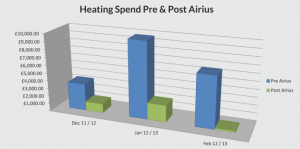
In the UK, Lush Cosmetics achieved remarkable heating savings with destratification:
- ROI ≈ 26 days.
- 61% energy saving on the heating system.
- Heating spend pre‑Airius: £26,638.83.
- Heating spend post‑Airius: £7,333.38.
- £2,967.50 — full system and installation cost.
- £68.75 — Airius system annual running cost.
- Process heat now recirculated for free heating.
Siemens rail maintenance facility offers another example:
- ROI: under 18 months.
- £12,106 — first‑year saving.
- £19,799 — full system and installation cost.
- 1,141,113 kWh — usage before Airius.
- 709,956 kWh — usage after Airius.
- Installed into Acton rail maintenance shed.
- System: 26 Airius Model 45 units.
- Approx. 75 tonnes annual CO₂ reduction.
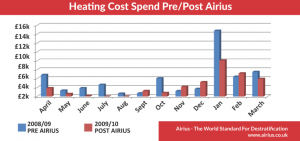
Impress Metal Packaging also achieved a 3‑month ROI:
“Overall savings taking into account lower temperatures and prices in winter 08/09 = 45.07%. The full cost of the Airius units is recouped within a matter of months — first winter savings of £62,351 measured against a total spend of £21,268.” – Paul Matten (Plant Engineer)
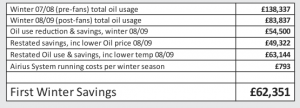
These UK examples reflect colder climates, but stratification occurs in any building in winter. We still need heating in Australia, even if for shorter periods (except perhaps in parts of Tasmania).
It is important to note that these percentage savings apply whether or not you have already improved the efficiency of your system.
You may have invested heavily in higher‑efficiency chillers or boilers, insulated ductwork or improved controls. Yet you still cannot adjust the thermostat in summer while maintaining similar comfort unless you use air circulation as a cooling substitute — and in winter, your hot air will continue rising away from where it is needed.
So, no matter how efficient you make your system, the suggestions in this blog can still offer significant energy savings. The percentages may remain similar, but the absolute amounts of energy saved will change alongside overall consumption.
If you have not yet implemented cooling or heating energy‑saving measures, or have only made basic changes such as lighting upgrades, this approach may offer a low‑cost, simple and effective way to reduce cooling and heating energy bills.
Airius offers a simple, proven and effective option — a straightforward, easy‑to‑install, relatively low‑tech solution to saving significant percentages of the air‑conditioning component of your electricity bills.
Key attributes:
- Very low running costs.
- Minimal operational interruption.
- No or minimal maintenance.
- Simple installation.
- No commissioning or complex programming.
What Types of Buildings Will This Work In?
The concepts in this blog apply to many building types, including supermarkets, sports halls, warehouses, libraries, museums, atriums, train stations and prisons.
Cooling air movement and winter stratification are physics issues that occur in all building types — simply to varying degrees.
These principles apply in buildings from roughly 2.5–40 metres high.
Generally, the greater the building height, the more stratification occurs in winter — and the greater potential heating energy savings. In summer, higher buildings need more air flow to achieve cooling at floor level.
However, achieving savings is not difficult if you use the right type of air‑movement equipment.
Sounds promising, doesn’t it?
If you are serious about saving large amounts of cooling and heating energy in a simple way and want to learn more about air movement for cooling and effective destratification in winter, call Airius in Australia on +61 (0) 401 848 888.
We can provide scientific know‑how and a range of solutions.
Airius can not only improve comfort in your buildings, but also save you energy — potentially a substantial amount.