

What does the science say?
As temperatures around the world become warmer, a clearer understanding of thermal comfort requirements during heatwave conditions becomes increasingly important.
If we do not understand how to deal with heatwaves, building occupants may experience extreme discomfort and, in worst-case scenarios, suffer severely from overheating. Under extreme heatwave conditions, death is possible. This is because one of the main health outcomes of overheating is cardiovascular strain, as the body works harder to remove heat in poor heat-removal conditions.
Thermal comfort
In order to maintain a fixed core body temperature, the human body must balance the rate at which it produces heat, arising as a by-product of cellular metabolism, with the rate at which heat is dissipated to the surrounding environment. Human heat dissipation occurs via dry heat transfer, such as conduction and convection, and latent heat transfer, such as evaporation.
However, above certain temperatures, when the air is above the body’s temperature, usually considered to be 35.5°C, the gradient for dry heat loss is reversed and heat is added to the body rather than lost. O. Jay, M. Cramer et al, 2015.
In Australia, the last 15 out of 17 years, according to BOM data cited in the original article, were among the hottest on record. Anthropogenic climate change or not, the climate is changing and warm days are becoming more prolific and consistently higher in temperature.
Climate projections show that extreme heat events are expected to occur more often and with greater intensity in the future.
Bureau of Meteorology, 2018.
Heatwaves are classified into three types based on intensity: low intensity, severe and extreme.
Once a heatwave reaches severe intensity, impacts on the health of elderly, sick and young people, as well as infrastructure, may be experienced.
The Bureau of Meteorology defines a heatwave as three or more days in a row when both daytime and night-time temperatures are unusually high in relation to the local long-term climate and the recent past.
In many cases around Australia, the methodologies available to improve thermal comfort at extreme temperatures may be limited.
Air conditioning is not always designed to deal with 45–55°C days unless it is significantly overdesigned. Even where it is overdesigned, it will not necessarily be optimally effective at those extreme temperatures. It may, of course, be better than no air conditioning, but a lot of money can be spent on purchasing an oversized unit that may only be needed for a limited number of days each year. It may also run inefficiently for most of the usual climatic conditions it encounters.
Not everybody can afford or wants air conditioning. Air conditioning also has little effect in open spaces such as stadiums, bus stops, exposed shelters or other unenclosed areas open to the outside environment.
So what can we do?
The use of fans for cooling has been around for millennia and works on a simple principle. Air movement from a fan helps evaporate moisture produced on the skin by the body as it attempts to cool itself. Generally, the more air movement there is, the faster the cooling effect.
For example, if you go to a gym or ride your pushbike during a very hot and humid day and create large amounts of perspiration, standing in front of a fan can offer an instant and rapid cooling effect, with a significant drop in perceived temperature and improved comfort.
This chart highlights earlier research on the value of air movement for cooling in warm and humid environments. As a fan engineering and manufacturing company, Airius pays close attention to the impact of heatwaves on the population. We follow scientific research to keep our knowledge as up to date as possible around what makes people comfortable and how fans can assist with improving thermal comfort during extremely hot days.
As we design fan systems for both cold and warm climates, our understanding is influenced and informed by thermal comfort research.
What constitutes a heatwave varies from country to country.
In England, a heatwave may be 36°C with humidity levels of 60–70%.
In New York, it may be 43°C with 30–60% humidity. In Australia, 45–51°C with varying levels of humidity from 10–60% can constitute heatwave conditions. There will be many examples of those temperatures being experienced in non-conditioned spaces or zones, both internal and external.
Until recently, many countries did not recommend the use of fans in heatwave conditions. The thermal comfort research around extreme temperatures was limited, had not fully considered heatwave conditions, and was influenced by concerns around the loss of moisture from the body at high temperatures contributing to dehydration.
While fans are excellent at cooling under a broad range of climatic conditions, general acceptance among some authorities and experts was that dehydration occurring when using fans at high temperatures could be detrimental and may cause illness or related negative impacts.
In addition, the physics indicates that when outside air temperature is higher than skin temperature, heat can be absorbed back into the skin, and fans were believed by some to make that worse.
The use of fans at very high levels of heat has therefore been viewed as potentially exacerbating dehydration, and an upper temperature limit for the use of cooling fans has influenced heatwave coping methodologies recommended by government health services around the world.
However, as heatwaves have become more regular, there has understandably been limited research on the best methodology for cooling people above 45°C with varying levels of humidity. Humidity plays a large role in both the efficacy of fans and the impact of heat on the body.
Consider what different countries and cities experience as heatwave conditions.
For example, in Sydney it may be 46°C with relative humidity of 10–20% over three days. In Washington DC, it may be 41°C and 20% relative humidity. In Newark, USA, it may be 44°C at 30% relative humidity. In Paris, it may be 29°C but with 90% relative humidity. O. Jay, M. Cramer et al, 2015.
Some historical public-health advice recommended lower maximum temperatures for the use of fans for cooling. For example, advice cited in the original article from the CDC in the United States and the NHS in the United Kingdom stated that fans may not prevent heat-related illness at air temperatures above 35°C or in the “high 90s” Fahrenheit.
However, Jay and Cramer argued that these limits may underestimate the increase in evaporative potential with fan use.
Numerous government departments, including the NHS in the UK and EPA in the USA, have historically stated that using an electric fan when the heat index exceeds 99°F, or 37.2°C, can increase the heat stress the body must respond to by blowing air warmer than ideal body temperature over the skin surface.
Without getting too technical, Jay and Cramer argued that these statements violate fundamental biophysical laws.
As climatic temperatures increase, these types of recommendations may become outdated as more research emerges around thermal comfort in heatwaves and the value fans can provide for cooling and improving comfort.
There is research and scientific calculation indicating that the value of perspiration for removing internal body heat loads can be higher than the increase of heat entering the body through the use of fans.
Even though cardiovascular failure is the principal cause of death in heatwaves, particularly among the elderly, it has been suggested that electric fans contribute to additional physiological strain because of more rapid dehydration.
Ollie Jay and colleagues, in their 2015 research undertaken at the University of Sydney, suggested that in physiologically compensable environments with a relative humidity of 20% or greater, predicted sweat losses without a fan are actually greater than with a fan.
They also suggested that even at extreme temperatures of 46°C with very low relative humidity of 10%, the extra evaporation created by the use of a fan can be compensated through the ingestion of a small amount of water.
They argued that incorrectly advising the public to stop using fans altogether, or modify their use by reducing convective flow across the skin, because of the notion that a fan will exacerbate thermal strain and dehydration, may place individuals at greater risk. O. Jay, M. Cramer et al, 2015.
This research into the use of fans during heatwave conditions indicated some interesting and surprising outcomes. Certainly, as humidity increases, the value of air movement from fans decreases. However, studies of air movement in tropical environments, including research in Thailand, India and other warm climates, have shown that increased air movement can comfortably offset thermal discomfort at high indoor temperatures without compromising the overall acceptability of the environment.
Research by M. A. Indraganti et al in 2012 also details that air movement is an important way to achieve physiological comfort at high temperatures, as it affects both evaporative and convective heat losses from the human body.
For example, even at 51°C with 10% relative humidity, the 2015 O. Jay et al study indicates that fans can provide some improvement in thermal comfort. As the value of fans becomes less at higher humidity and temperature, they may still slow the rate of physiological change related to overheating.
“Irrespective of relative humidity, electric fans increase the critical air temperature at which both elevated cardiovascular and thermal strain occurs, by approximately 3–4°C in both the young and elderly.”
O. Jay et al, 2015.
Research by Ollie Jay et al in 2015 indicated that the critical environmental limit at which fan use becomes harmful in Sydney, for example, is 51°C. That is significantly above some historic thinking around temperature, overheating and fan use.
Reviewing this research offers insights into thermal comfort requirements for the heatwave conditions now faced each summer. These conditions may become more prevalent as the century progresses. Fans may therefore take an important role in helping to address overheating in both indoor and outdoor applications.
As a manufacturer of hidden-blade fans designed for a broad range of applications, Airius offers systems that can provide small to large volumes of air movement at different velocities in different types and sizes of space.
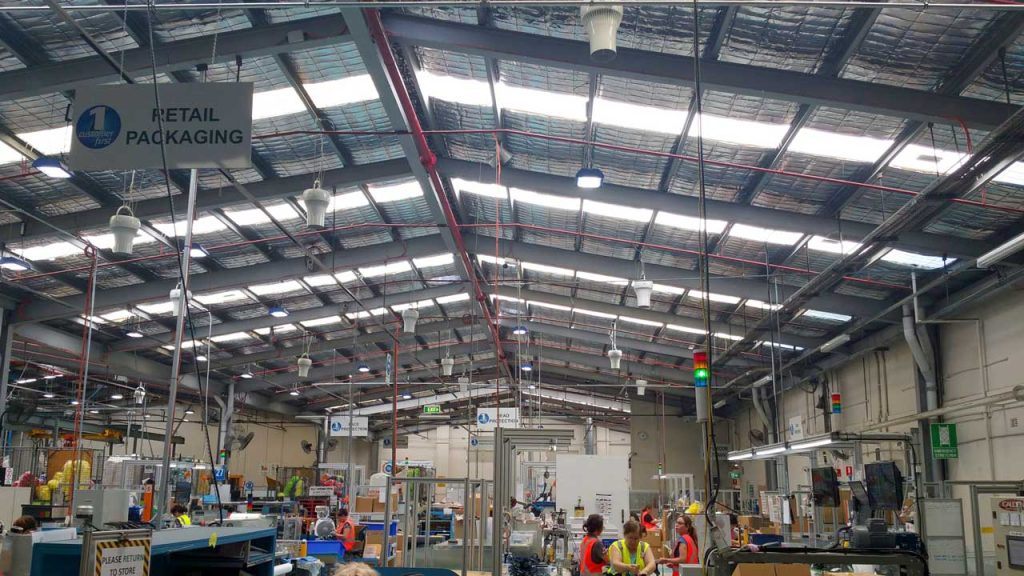
These fans are now being utilised across a range of facilities where overheating has been a major concern, including sports halls, warehouses, theatres, offices, classrooms and gymnasiums.
Outdoor spaces such as bus stops, queues for functions or rides, covered areas, sports stadiums and other similar unenclosed spaces can also benefit from the use of fans to provide cooling.
While working as a fan system rather than a single fan, Airius can also deliver air to where it is needed. That is a unique design outcome from using Airius fans.
All other types of fans move air, but they do not necessarily move air anywhere in particular. Airius provides air movement too, lots of it if needed, but also offers controllability, directionality and point-to-point delivery capability.
Using proven engineering, design and manufacturing expertise gained from thousands of worldwide installations, Airius can work with you to create cooling solutions for your facilities.
Even if temperatures reach extreme levels, Airius fans can help improve thermal comfort in a range of indoor and outdoor applications.
Airius can help you choose the right fan system for your building, application and airflow requirements.
Bibliography
O. Jay et al. / Applied Ergonomics 46 (2015) 137–143. Accessed 1 February 2018.